
Walk into any store today and you feel it. There’s less staff, less time, and less margin for error. Head office wants better reporting, customers want faster service, and the people running the floor are holding it together across disconnected systems and manual tasks.
Store managers aren’t just running stores anymore. They’re running operations engines. Every task they re-prioritize, every delay they catch, every decision they make in the moment lands on revenue, labor cost, and customer experience.
This is where AI changes the job. Not the version in a lab or a keynote, the version already on the floor: predicting demand before shelves run empty, aligning staffing to real traffic, flagging a non-compliant display before an area manager walks in, and putting answers in an associate’s hand without sending them to the back office.
Here’s the honest part most guides skip. The technology is the easy bit. The hard bit is making it work in a low-margin, high-variability, human environment where every minute counts. Most retail AI investment has gone to the back office, supply chain, pricing, ecommerce. The store floor, the layer that determines whether any of it pays off, is where most retailers have invested the least.
This guide breaks down where AI is genuinely working in store operations in 2026, the proof behind it, and what it takes to get results.
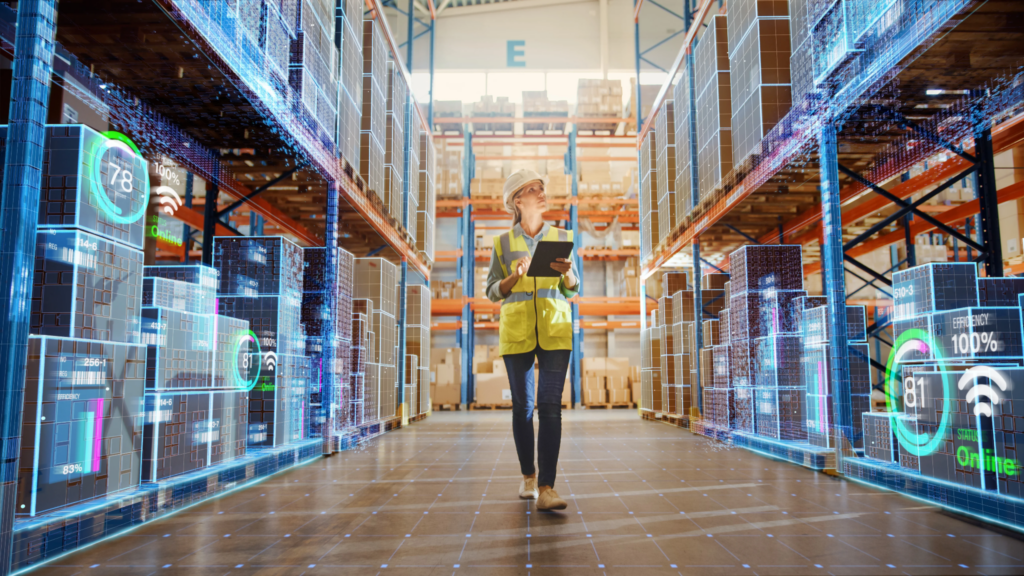
What is AI in store operations?
AI in store operations is the application of machine learning and data intelligence to how store work actually gets done, from replenishment and scheduling to shrink prevention and floor execution. It’s not about replacing people. It’s about helping them do more, with less friction.
AI has powered ecommerce and logistics for years. What’s different now is that it’s driving day-to-day decisions inside the four walls of the store, and that shift is accelerating fast. Active AI deployment in retail reached 58% in early 2026, a 16-point jump in a single year (NVIDIA, State of AI in Retail, 2026).
At YOOBIC, AI is embedded across task management, frontline communications, and mobile learning in a single app that already supports millions of workers on every shift, used by more than 350 global brands. The point isn’t AI as a feature bolted on the side. It’s AI woven into the work itself.
How does AI improve retail inventory and demand forecasting?
AI reads real-time sales, seasonality, local events, and external signals to forecast demand at SKU level, so teams restock before they run out and stop over-ordering stock that sits and ages. It moves inventory from gut feel to data-driven precision.
The size of the prize is hard to overstate. Retailers lose between $1.73 trillion and $1.77 trillion every year to inventory distortion, the combined cost of overstocks and out-of-stocks (IHL Group, 2026). For a typical retailer that works out to roughly a 6.5% tax on the P&L.
20% to 50%
decrease in forecasting errors with AI demand planning
McKinsey Supply Chain 4.0, 2026
But a forecast only matters if someone acts on it. Morrisons runs 400 to 600 AI cameras per store to spot empty shelves, and those alerts automatically trigger replenishment tasks in the YOOBIC app used by 70,000 colleagues. The camera spots the problem, and the workflow drives the fix. That’s the difference between knowing a shelf is empty and actually filling it.
How does AI improve staffing and scheduling without adding burnout?
AI forecasts foot traffic by hour, by store, and by event, then aligns staffing to it. This isn’t about cutting hours. It’s about putting the right people on the floor at the right time, so teams aren’t stretched thin at peak or standing idle when it’s quiet.
The case is straightforward. Labor is 60% to 70% of controllable store operating costs, and AI-driven workforce management delivers up to a 25% improvement in workforce productivity, around 9.8 reclaimed hours per associate per month (McKinsey Global Institute, 2026). Less burnout for associates, fewer delays for customers, more control for managers.
Hugo Boss saw what reclaimed time looks like in practice. Putting AI recommendations in store teams’ hands saved 25% of their administrative time, and came with a 3.2% lift in incremental revenue. Time off admin is time back on the customer.
How does AI reduce shrink and loss at checkout?
AI uses computer vision and smart sensors to flag mis-scans, concealment, and checkout anomalies in real time, and to speed up self-checkout, often without adding headcount. Modern systems don’t just record footage for later. They analyze behavior as it happens and help teams act before losses escalate.
Shrink has become one of retail’s biggest operational drains. US retailers lost $90 billion to shrink last year, and 73% of it, around $66 billion, is preventable (Appriss Retail, 2026 Total Retail Loss Benchmark Report). Checkout is where a lot of it leaks: self-checkout lanes without computer vision run a 3.5% shrink rate, against 0.21% for staffed lanes.
A large share of shrink isn’t theft at all. Operational error, mis-counts, pricing mistakes, broken process, accounts for roughly a quarter of total losses. That’s the slice store execution can actually close. YOOBIC’s VM Copilot uses AI image recognition to verify that displays and campaigns are set correctly, flagging the execution gaps that quietly cost margin before they ever reach a P&L.
How do store associates actually use AI on the floor?
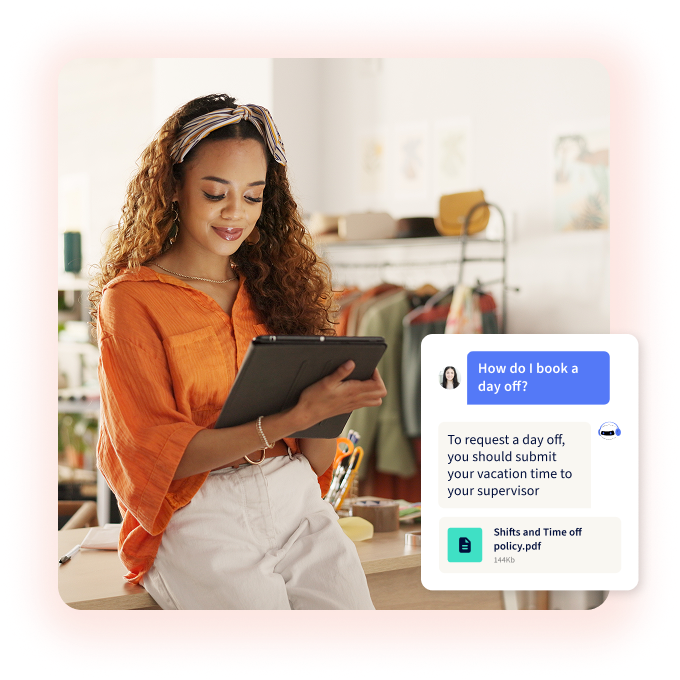
Associates use mobile AI assistants to pull stock levels, product details, and loyalty history without leaving the customer, verify a display from a single photo, and learn in the flow of the shift. AI puts back-office intelligence directly in the associate’s hand.
The time savings are real. AI-assisted planogram and compliance checks have cut the time associates spend on daily manual checks by 78%. That’s time handed back to selling and serving.
There’s a catch worth naming. Frontline AI adoption has stalled at 51%, against more than 75% for managers, mostly because frontline teams aren’t trained or supported to use the tools. The tools have to be genuinely easy, or they don’t get used.
This is the layer YOOBIC was built for. Longchamp saves 10 hours a week on training content and rolls it out globally in six days. PureGym teams asked and resolved nearly 2,000 questions on the NEO Assistant in the first month alone, answered on the spot instead of routed through managers or central inboxes. That’s AI the frontline actually picks up.
What does it take to make AI work in stores?
The technology is rarely the reason AI fails in retail. People, process, and data quality are. Between 70% and 80% of retail AI initiatives miss their objectives, and only 6% see positive ROI in under a year, with most taking two to four years to deliver stable returns (Stanford/BetterUp and Gartner, 2026).
A few things separate the projects that work from the ones that stall:
- Start with a number, not a strategy. “We need an AI strategy” produces expensive pilots that never scale. “37% of our displays are executed incorrectly” produces measurable ROI. Find the gap, tie it to a metric, then find the tool that closes it.
- Fix the foundation first. AI is only as good as the data feeding it. Disconnected systems and inaccurate shelf data turn smart tools into noise.
- Win trust on the floor. The biggest barrier to frontline adoption is trust, not awareness. If teams don’t believe the tool understands their reality, they won’t use it.
That last point is decisive. Adoption is the difference between a pilot and a platform, and it’s where YOOBIC’s 90% user adoption rate matters most. The smartest system in the world changes nothing if nobody on the floor opens it.
The takeaway for store and ops leaders
AI in retail store operations is no longer a future concept. From inventory precision to dynamic staffing to real-time loss prevention, it’s already reshaping how stores run. It’s not a threat to store teams. It’s a co-pilot that takes the weight off admin, sharpens decisions, and frees people to focus on what matters most.
But the payoff is decided on the store floor. A perfect forecast fails if the product stays in the stockroom. A flawless promotion fails if associates don’t know about it. An AI-generated planogram fails if nobody verifies it was set. AI’s promise meets retail’s reality at the frontline, and that’s exactly the layer most retailers have underinvested in.
YOOBIC brings task management, communication, and frontline learning together in one mobile-first platform, powered by AI and built for store teams. If you’re ready to bring AI to the most important layer of your business, the frontline is the place to start.
Book a demo and find out how
Avoid wasted hours, blind spots
and lost revenue with YOOBIC
Frequently asked questions
How can AI be used in retail?
AI is used in retail to forecast demand, align staffing to real foot traffic, flag shrink at checkout, and verify in-store execution. It also powers mobile assistants that hand associates stock levels, product details, and answers on the floor. The biggest gains sit inside the store, where AI turns data into the next task a team should act on.